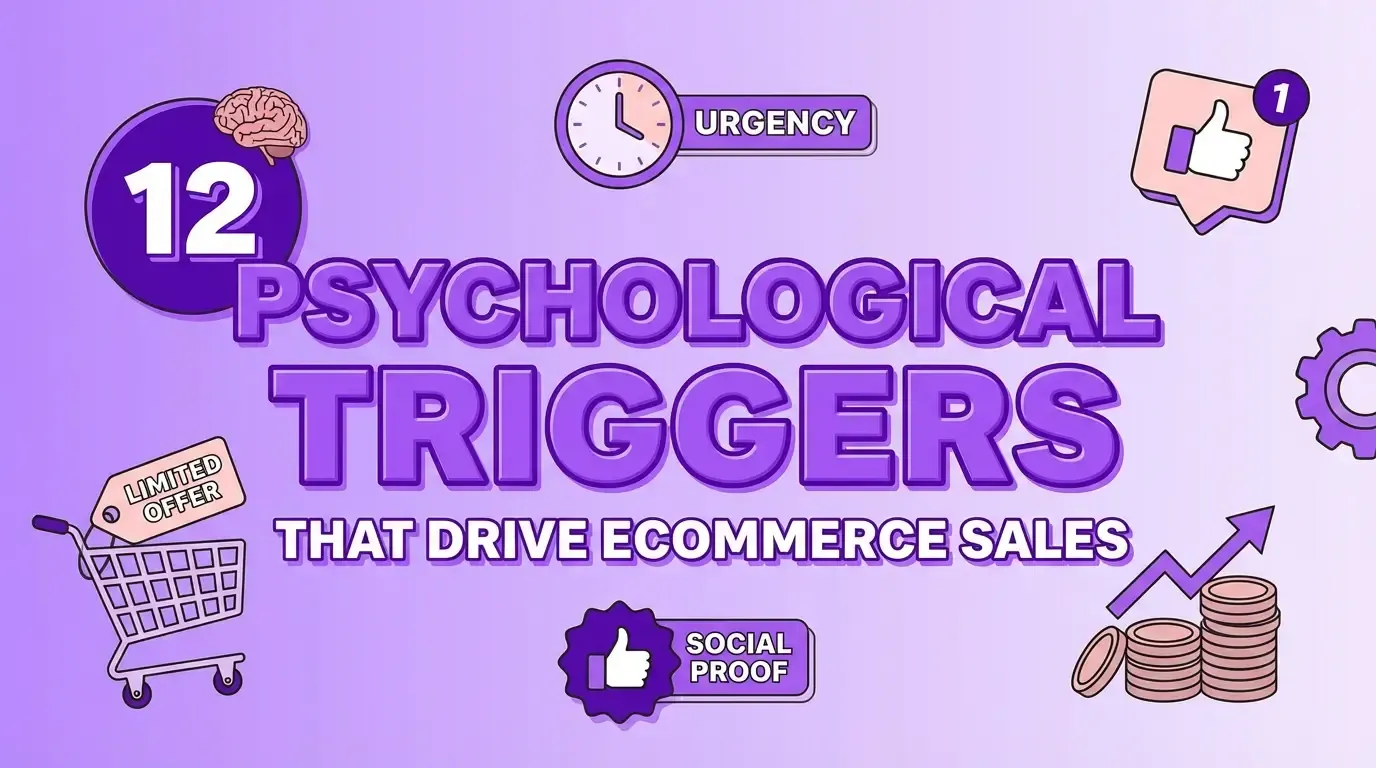
12 Psychological Triggers That Drive Ecommerce Sales in 2026

In this article
- Why Psychological Triggers Increase Ecommerce Conversions
- 12 Psychological Triggers That Boost Online Store Sales
- How Emotion and Logic Shape Online Buying Decisions
- Psychological Trigger Mistakes That Kill Conversions
- How to Measure Psychological Trigger ROI
- Turn Visitor Psychology Into More Ecommerce Sales
- FAQs About Psychological Triggers for Ecommerce
Most shoppers don’t realize why they clicked “add to cart.” The decision felt logical, but it was probably triggered by a subtle cue—a low-stock warning, a five-star review, or a notification showing someone else just bought the same item.
These psychological triggers aren’t manipulation; they’re how humans have always made decisions. Online stores just have to recreate them digitally since there’s no salesperson or busy crowd to do the work.
This guide breaks down 12 proven triggers, shows you where ecommerce stores get them wrong, and explains how to measure whether they’re actually working.
Why Psychological Triggers Increase Ecommerce Conversions
Psychological triggers are mental shortcuts that influence buying decisions—and ecommerce stores that use them well typically see conversion lifts between 10–25%. Triggers like scarcity, social proof, and reciprocity tap into emotions and cognitive biases that speed up purchasing decisions.
The goal? Recreate the feeling of a busy, trusted store through strategic on-site signals.
Here’s the thing: online stores face a challenge that physical retailers don’t. There’s no salesperson to answer questions, no crowd to signal popularity, and no way for shoppers to touch products before buying.
Psychological triggers fill that gap. They show real activity, create urgency, and reduce the mental friction that causes visitors to leave empty-handed.
- Psychological trigger: A stimulus that prompts an emotional or behavioral response
- Why triggers work online: Digital stores lack physical cues like crowds and salespeople
- The goal: Make your site feel active, trusted, and worth engaging with
12 Psychological Triggers That Boost Online Store Sales
1. Social Proof
Social proof is the tendency to follow what others are doing—especially when we’re uncertain. When shoppers see other people buying, reviewing, or engaging with a product, they feel more confident doing the same.
Think about it like walking past two restaurants: one empty, one packed. Most people choose the busy one, even without knowing anything about the food.
Customer reviews, testimonials, and real-time purchase notifications work the same way online. They transform an empty-feeling website into one that feels active and trustworthy. Tools like ProveSource automate this by displaying live activity feeds—recent purchases, signups, visitor counts—without any coding.
2. FOMO and Scarcity
FOMO—fear of missing out—kicks in when shoppers believe an opportunity might disappear. Scarcity amplifies this by signaling limited availability, which makes items feel more valuable.
“Only 3 left in stock” works because our brains are wired to value scarce resources more highly. Limited-edition drops and exclusive collections tap into the same psychology.
The key here is authenticity. Fake scarcity erodes trust quickly, while genuine low-stock alerts create legitimate urgency that moves people to act.
3. Urgency
Urgency differs from scarcity in one important way: it’s about time, not quantity. Countdown timers, flash sales, and “offer expires tonight” messaging all create time pressure.
When people feel time slipping away, they’re less likely to overthink or comparison shop. However, urgency loses its power if every sale has a countdown timer—shoppers learn to ignore signals that never actually expire.
4. Authority and Trust Signals
The authority principle explains why people defer to experts and credentials. In ecommerce, this translates to trust badges, security seals, expert endorsements, and media mentions.
New visitors especially need visible credibility cues before they’ll enter payment information. Trustpilot research found 98% of customers can identify trust symbols that increase their likelihood to buy—a first-time shopper doesn’t know you yet, so third-party validation does the heavy lifting.
- “As seen in” media logos
- SSL and payment security badges
- Industry certifications or awards
- Expert or influencer endorsements
5. Reciprocity
Reciprocity is the social norm that when someone gives us something, we feel obligated to give back. In ecommerce, this shows up as free shipping thresholds, first-time visitor discounts, and free guides or samples.
The psychology is straightforward: give value first, and shoppers feel a subtle pull to return the favor. Even small gestures—like a helpful size guide or styling tips—can trigger this response.
6. Loss Aversion
Loss aversion means that losing something feels roughly twice as painful as gaining something feels good. Smart ecommerce messaging frames decisions around what shoppers will miss, not just what they’ll gain.
Abandoned cart emails that say “Don’t lose your items” or “Your cart expires in 24 hours” tap directly into this bias. The fear of losing something we’ve already mentally claimed is a powerful motivator.
7. Price Anchoring
Anchoring happens when the first number we see influences how we perceive all subsequent numbers. Showing the original price crossed out next to the sale price makes the discount feel more significant.
$89 — the crossed-out price sets the anchor.
Premium-tier products serve a similar function. Even if few people buy the $500 option, it makes the $200 option look like a reasonable middle ground.
8. The Endowment Effect
The endowment effect explains why people value things more once they feel ownership. Wishlists, saved carts, and “your items are waiting” messaging all create a sense of psychological ownership before the actual purchase.
Customization tools work the same way. When shoppers spend time personalizing a product—choosing colors, adding monograms—they become more attached and more likely to complete the purchase.
9. Personalization
Personalization makes shoppers feel seen and understood—McKinsey found 71% of consumers expect personalized interactions. Product recommendations based on browsing history, personalized email subject lines, and “recommended for you” sections all increase relevance.
When content feels tailored rather than generic, shoppers pay more attention. The key is using data to show products that actually match their interests—not just random bestsellers.
10. The Default Effect
People tend to stick with pre-selected options rather than actively changing them. This is the default effect, and it shapes everything from subscription checkboxes to product bundle selections.
“Most popular” badges and pre-selected recommended options guide shoppers toward specific choices without feeling pushy. The default becomes the path of least resistance.
11. Curiosity
The curiosity gap is the urge to fill a knowledge gap. Mystery offers, “unlock your discount” popups, and teaser messaging all leverage this drive.
When shoppers don’t know what’s behind the click, they’re more likely to engage just to find out. The key is delivering on the promise—curiosity that leads to disappointment backfires quickly.
12. Commitment and Consistency
Once people take a small action, they’re more likely to take larger actions that align with it. This is the commitment and consistency principle.
Micro-commitments like email signups, quiz completions, or wishlist additions create a psychological thread. Shoppers who’ve already engaged feel more invested and are more likely to eventually purchase.
How Emotion and Logic Shape Online Buying Decisions
Shoppers don’t make purely rational decisions—they decide emotionally first, then justify with logic afterward. Understanding this sequence helps you deploy the right triggers at the right moments.
| Decision Phase | Dominant Driver | Triggers That Work |
|---|---|---|
| Initial interest | Emotion | Social proof, FOMO, curiosity |
| Evaluation | Logic | Authority, price anchoring, reviews |
| Final commitment | Both | Urgency, loss aversion, consistency |
Early in the journey, emotional triggers like social proof and curiosity capture attention. During evaluation, logical triggers like authority signals and pricing comparisons satisfy the rational brain. At checkout, a combination of urgency and loss aversion pushes shoppers over the finish line.
Psychological Trigger Mistakes That Kill Conversions
Overusing Urgency and Countdown Timers
When every sale has a countdown timer that resets daily, shoppers learn to ignore it. Fake urgency trains your audience to distrust your messaging entirely.
Reserve countdown timers for genuine limited-time offers. If the timer resets when the page refreshes, you’re eroding trust faster than you’re creating urgency.
Displaying Fake or Misleading Social Proof
Fabricated reviews and inflated visitor counts might seem like shortcuts, but shoppers can often detect inauthenticity. Platforms also penalize fake reviews, and the reputational damage outlasts any short-term gains.
Authentic social proof—even if the numbers are smaller—builds genuine trust. Real-time notifications showing actual purchases are far more credible than suspiciously round numbers.
Ignoring Mobile Shoppers
75% of ecommerce traffic comes from mobile devices, yet many psychological triggers are designed for desktop experiences. Intrusive popups that work on large screens frustrate small-screen users.
Notifications and urgency messaging work best when they’re responsive and non-obtrusive on mobile. A popup that covers the entire screen on a phone isn’t persuasive—it’s annoying.
Stacking Too Many Triggers at Once
Cognitive overload is real. When shoppers encounter multiple popups, notifications, countdown timers, and urgency messages simultaneously, the result is chaos rather than conversions.
Start with one or two triggers and measure their impact before adding more. Sometimes less is genuinely more.
How to Measure Psychological Trigger ROI
A/B testing is the most reliable way to measure whether psychological triggers are actually working. Run controlled tests comparing pages with and without specific triggers, then track the difference in key metrics.
- Conversion rate before and after adding triggers
- Click-through rate on notifications or popups
- Time on page and bounce rate changes
- Revenue per visitor comparison
Most social proof tools, including ProveSource, include built-in analytics that track notification performance. This makes it straightforward to see which triggers drive engagement and which ones shoppers ignore.
Turn Visitor Psychology Into More Ecommerce Sales
Psychological triggers work because they address universal human behaviors—uncertainty, social influence, and fear of loss. You don’t have to implement all twelve at once.
Start with social proof and urgency, since they’re the easiest entry points and often deliver the fastest results. From there, layer in additional triggers based on what your data shows.
The stores that convert best aren’t necessarily the ones with the best products—they’re the ones that understand how shoppers actually make decisions.
FAQs About Psychological Triggers for Ecommerce
What is the most effective psychological trigger for ecommerce stores?
Social proof tends to be the most universally effective because it reduces uncertainty and builds trust quickly. That said, the best trigger depends on your specific product, price point, and audience—high-ticket items often benefit more from authority signals, while impulse purchases respond well to urgency.
Are psychological triggers ethical to use in online stores?
Yes, when used honestly. Psychological triggers become unethical only when they deceive customers through fake scarcity, fabricated reviews, or misleading claims. Ethical social proof and FOMO—authentic triggers that reflect real activity and genuine offers—is simply good communication.
How do psychological triggers work differently for high-ticket ecommerce products?
High-ticket purchases require stronger authority and social proof signals because buyers want greater reassurance before committing to larger investments. Detailed reviews, expert endorsements, and money-back guarantees carry more weight when the price tag is significant.
What tools automate psychological triggers on Shopify stores?
Social proof apps like ProveSource automatically display real-time purchase notifications, visitor counts, and review popups without requiring any coding. Apps like ProveSource integrate directly with Shopify and pull live data from your store’s actual activity.
How often should ecommerce stores refresh psychological trigger tactics?
Review your trigger performance monthly and refresh creative elements quarterly to prevent audience fatigue. Shoppers who see the same notifications repeatedly start to tune them out, so rotating messaging and testing new approaches keeps triggers effective.